Short answer: measure the drop along your bed. With a small drop of up to about 3 inches, dig the uphill side in. With a moderate drop of about 3 to 8 inches, use a taller or stepped kit. With a larger drop, build a terrace or get advice. These cutoffs are practical rules of thumb, not engineering limits.
Measure the drop
- Put a stake at each end of the planned bed.
- Tie a string between them and level it with a line level.
- Measure from the string to the ground at the low end, and subtract the same measurement at the high end.
- Repeat across the width. Slopes often run in two directions.
A slope of 1 inch per foot gives an 8-inch drop along an 8-foot bed, but only 4 inches across a 4-foot width. Turning the long side to run across the slope usually means far less digging.
Choose your method
| Drop along the bed | Method | What to buy or use |
|---|---|---|
| Up to about 3 in | Dig the uphill side into the ground and level the frame | Any standard kit, plus a level |
| About 3–8 in | Use a taller frame and bury it on the high side, or add a stepped lower board | A tall kit or stackable corner kit |
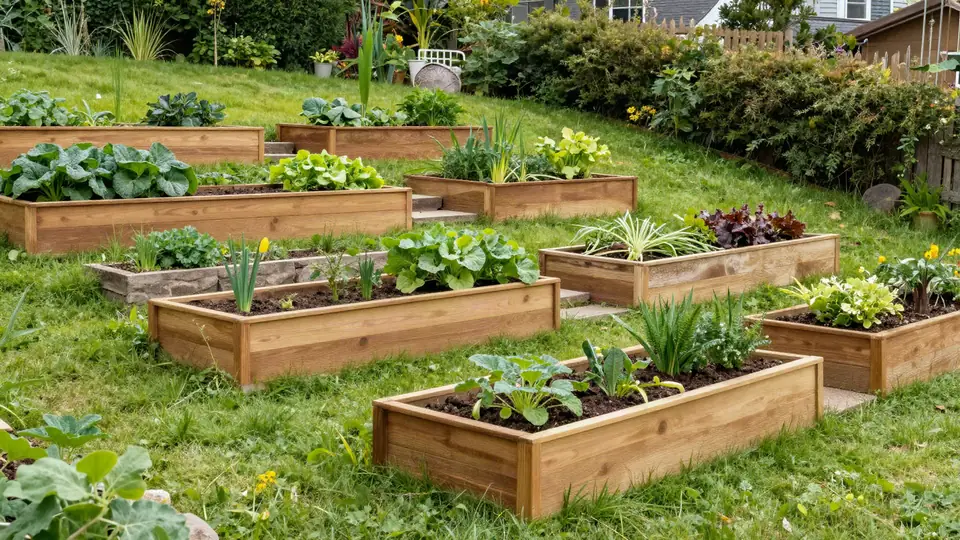
| Over about 8 in | Split into two shorter beds at different levels, or terrace | Two short beds and a firm step between them |
| Steep ground or unstable soil | Get local advice before building | A landscape contractor or structural advice |
Before you dig
In the US, call 811 or use your state's online request a few days before digging. It's free, and utility lines can be shallower than you expect.
- Watch where water runs in a heavy rain, and keep beds out of drainage paths.
- Compact the base so the low side doesn't sink.
- Anchor corners with stakes on the downhill side, as wet soil pushes outward.
- Check local rules before building any tall retaining wall. Many places require a permit above a set height.
Which kits work best on a slope?
Stackable corner kits
Corner brackets let you add a board only on the low side, which is a clean way to handle a moderate slope. You supply the lumber. See stackable corner brackets on Amazon.
Tall metal beds
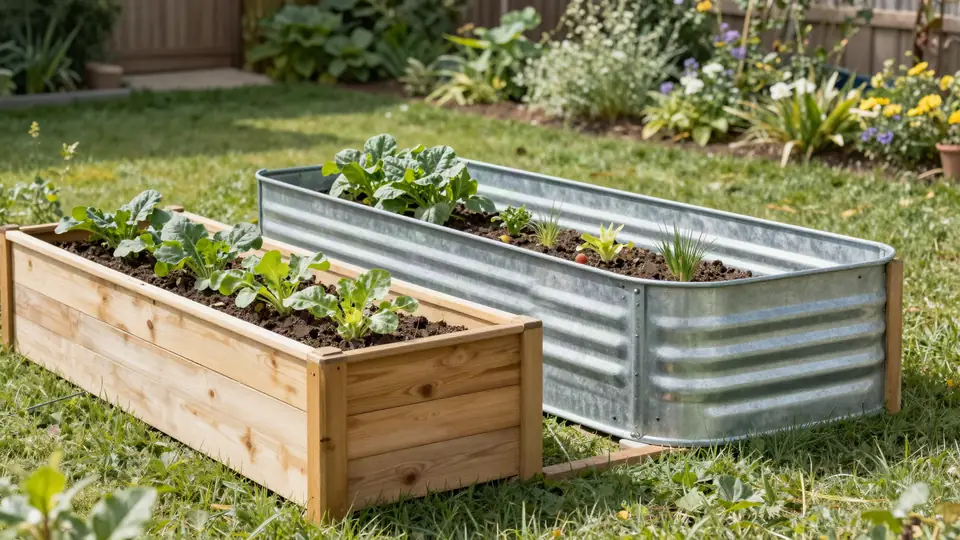
A 17-inch or taller bed leaves room to bury the uphill side and still keep useful depth. Metal panels are hard to cut, so plan on digging rather than trimming. See tall metal beds on Amazon.
Short beds in steps
Two 4 × 4 beds at different heights are often easier to level than one 4 × 8 bed. See 4 × 4 kits on Amazon.
Soil on a slope
A level frame on sloping ground holds more soil at the low end. Use the deepest point of the bed in the soil calculator for a safe upper estimate, or the average depth for a closer one.