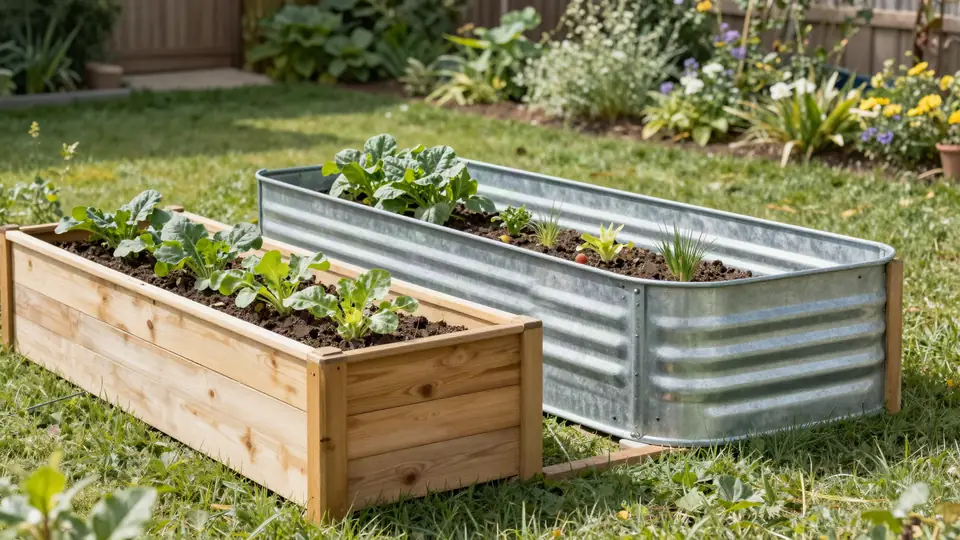
Short answer: choose galvanized steel if you want the longest life with no upkeep. Choose cedar if you prefer the look of wood, live somewhere with very hot summers, or plan to cut and customize the bed.
Side-by-side comparison
| Factor | Galvanized steel | Cedar |
|---|---|---|
| Typical lifespan estimate | 15–20+ years | 7–15 years, longer in dry climates |
| Upkeep | Almost none; check for scratches and loose bolts | Replace boards and hardware as they age |
| Soil heat | Sun-facing sides can warm the outer edge of the soil | Wood insulates better |
| Assembly | Bolted panels; many small fasteners | Often slot-together or screwed corners |
| Customizing | Hard to cut or adapt | Easy to cut, extend and attach hoops or trellises |
| Top edge | Choose rolled or capped edges, as raw metal can be sharp | Comfortable to lean on |
Treat lifespan numbers with caution. They come from mixed sources, not long-term controlled studies. Soil contact, moisture and climate change the result a great deal.
Is galvanized steel safe for vegetables?
Galvanized beds are widely used for food crops. Many quality kits add a powder or zinc-aluminum coating over the steel. Avoid reused metal of unknown origin, such as old roofing or industrial tanks, because you can't tell what coatings or residues it carries.
Does metal overheat the soil?
Metal does conduct heat, and dark or sun-facing panels can warm the soil along the edge. In a bed of normal width, the center stays cooler. Lighter colors, mulch, consistent watering and a little extra space between crops and the edge all help. If you live in a very hot desert climate, this is the strongest reason to favor wood.
What about treated lumber?
Modern ACQ-treated lumber does not contain arsenic, though it does contain copper. Advice varies. Some sources consider it acceptable for gardens, while others suggest avoiding it or lining the inner faces with plastic. Wear gloves and a mask when cutting it.
Avoid two older materials entirely: wood treated with CCA, which contains arsenic and was phased out of most residential use, and railroad ties treated with creosote.
Which should you pick?
Pick galvanized if
- You want to build once and forget it.
- You garden in a wet climate where wood rots quickly.
- You like a modern look.
Pick cedar if
- Your summers are very hot and sunny.
- You want to add hoops, trellises or a cold frame later.
- You may move the bed or change its size.
Checks before you buy either one
- Panel thickness: thin sheet bows under the weight of wet soil. Long beds need cross-bracing.
- Inside dimensions: listed sizes may be external. This matters for soil volume and for adding a cold frame.
- Wood grade: cedar heartwood resists rot better than pale sapwood, and sellers don't always say which they use.
- Hardware: look for stainless or coated screws. Cheap fasteners can fail before the boards do.