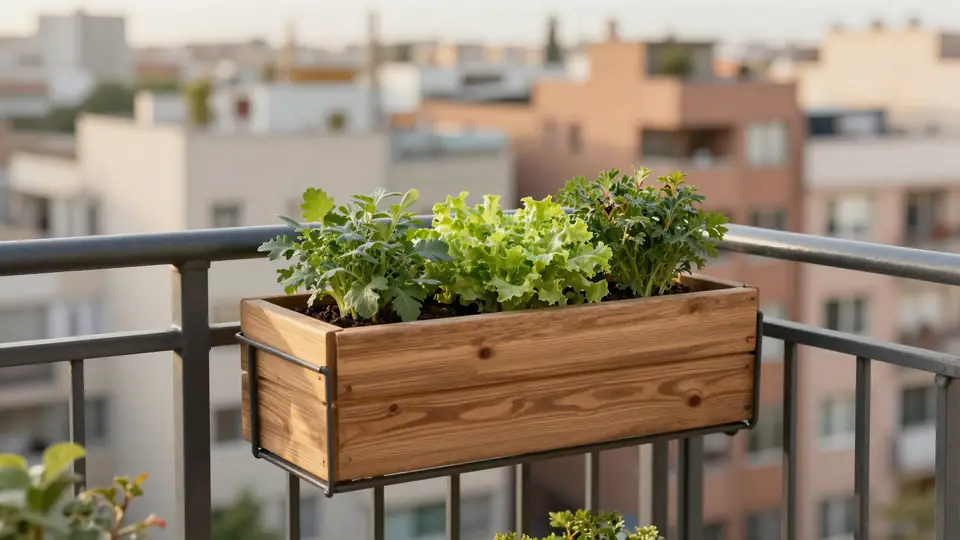
Short answer: a 2 × 4 foot elevated planter with 10 inches of soil can weigh about 370 to 430 pounds when wet, before you count the planter and plants. That is about 46 to 54 pounds per square foot, which is close to commonly quoted balcony ratings of 40 to 60. Ask your building for the real limit before you fill one.
Safety first. Balcony capacity varies by building, age and condition. The numbers here are for planning. Get the actual rating from your landlord, building manager or a structural engineer, and don't use a balcony that shows cracks, rust stains or sagging.
Two different limits
- The planter's rating is how much its frame can hold. A product listing may say something like 200 pounds. Compare this with your wet soil weight, because many planters are easy to overload.
- The balcony's rating is how much the structure can carry per square foot. It has to cover people, furniture and snow as well as your plants.
Do the math for your planter
- Find the soil volume. Length × width × depth, in feet. A 2 × 4 ft box filled 10 inches deep holds 2 × 4 × 0.83 = 6.7 cubic feet.
- Multiply by wet weight. Wet potting mix is often quoted at 55 to 65 pounds per cubic foot. Wet garden soil is far heavier at 90 pounds or more, so don't use it here.
- Add the rest. Add the planter, plants and any water in a reservoir. Water weighs about 8.3 pounds per gallon.
- Divide by the footprint. Total weight ÷ area in square feet gives you pounds per square foot.
| Planter | Soil depth | Volume | Wet soil weight | Per sq ft |
|---|---|---|---|---|
| 2 × 2 ft | 8 in | 2.7 cu ft | 147–173 lb | 37–43 lb |
| 2 × 3 ft | 8 in | 4.0 cu ft | 220–260 lb | 37–43 lb |
| 2 × 4 ft | 8 in | 5.3 cu ft | 293–347 lb | 37–43 lb |
| 2 × 4 ft | 10 in | 6.7 cu ft | 367–433 lb | 46–54 lb |
| 2 × 4 ft | 12 in | 8.0 cu ft | 440–520 lb | 55–65 lb |
Notice that weight per square foot depends on depth rather than planter size. Going shallower is the most effective way to cut the load.
Legs make it worse
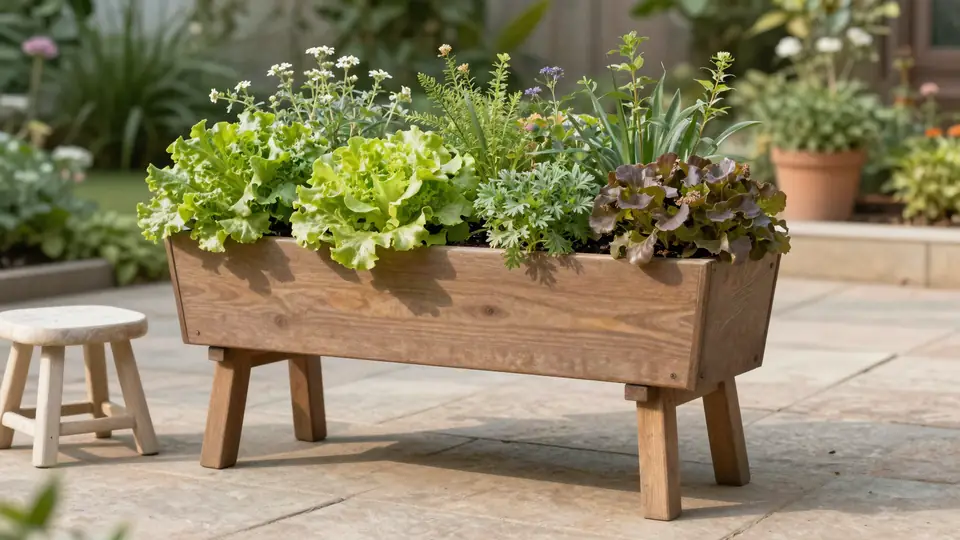
A planter on four legs puts its whole weight on four small points. Ratings are usually for evenly spread loads, so a legged planter can stress the surface more than the per-square-foot figure suggests. Placing boards beneath the legs can spread the load, but it doesn't raise the balcony's limit.
How to reduce the load
- Choose a shallow planter of about 6 to 8 inches and grow herbs, lettuce, radishes and bush beans.
- Use a light potting mix. Don't use garden soil.
- Place heavy items along the wall or over supporting beams, as your building advises, not out at the edge.
- Use several smaller containers rather than one large one.
Other balcony checks
- Your lease or HOA rules. Many limit balcony planters.
- Drainage. Use a saucer or drip tray so water doesn't fall on the neighbors below.
- Wind. Higher floors are windy. Keep anything light well away from the railing and never hang it on the outside.
What to look for
Shallow elevated planters with a stated load rating
A rating above your calculated wet weight, a drip tray and sturdy cross-bracing are the features to check. See elevated balcony planters on Amazon.
Fabric grow bags
They add very little weight and let you limit the volume of each container. See fabric grow bags on Amazon.
Lightweight potting mix
Check the product's own dry weight and volume on the bag. See potting mix on Amazon.