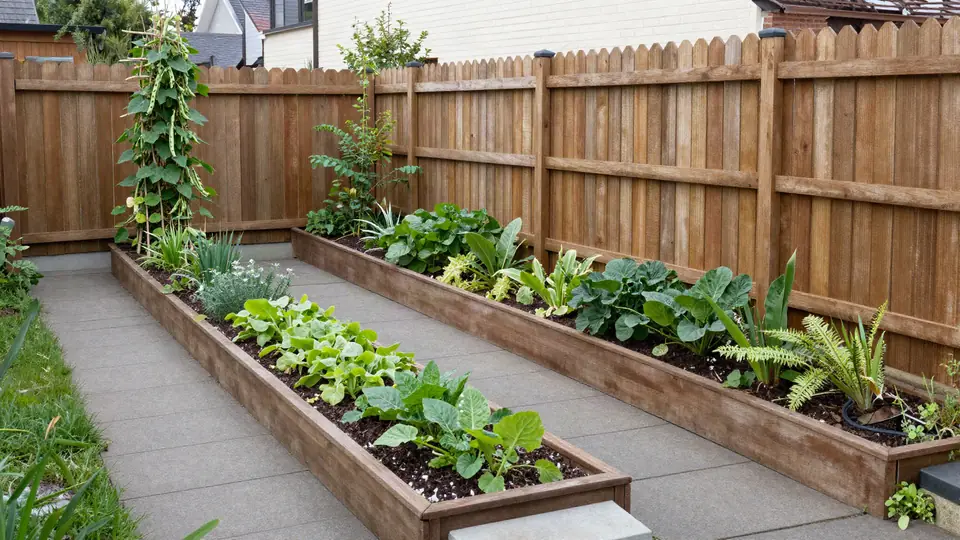
Short answer: a bed 18 to 24 inches wide suits most side yards. Leave at least 24 inches of walking room, and keep the bed a little away from the house wall. Before buying, track how many hours of direct sun the strip gets.
Work out your width
Start with the full width of the side yard, then subtract what you have to keep clear.
| Side yard width | Gap at wall | Path | Bed width left |
|---|---|---|---|
| 3 ft (36 in) | 4 in | 24 in | 8 in: use wall planters |
| 4 ft (48 in) | 4 in | 24 in | 20 in |
| 5 ft (60 in) | 4 in | 30 in | 26 in |
| 6 ft (72 in) | 6 in | 36 in | 30 in |
A bed you reach from only one side should be no more than about 2 feet wide. That is about half the 4-foot width suggested for beds you can reach from both sides.
Check the sun first
Side yards are often shaded for much of the day. Check the strip every hour or two on a clear day, ideally during the growing season, because winter shadows are longer.
| Direct sun per day | What usually works |
|---|---|
| 6–8+ hours | Tomatoes, peppers, beans, squash on a trellis |
| 4–6 hours | Lettuce, spinach, chard, peas, herbs such as parsley and mint |
| Under 4 hours | A challenge for most vegetables; try mint, or use the space for storage |
What must stay clear
- The house wall. Don't pile soil against siding or above the foundation line. Moist soil invites rot and pests. Keep a gap so air can move.
- Gas and electric meters. Utilities often require clear access. Check with yours first.
- Exits and gates. Keep a clear route for emergency access and bins.
- Drainage. Water should run away from the house, so don't block downspouts or slope soil toward the wall.
- Buried lines. Side yards often carry utility lines. Call 811 before digging into the ground.
Soil for narrow beds
| Size | Depth | Soil volume | 1.5 cu ft bags |
|---|---|---|---|
| 18 in × 6 ft | 12 in | 9 cu ft | 6 |
| 2 × 6 ft | 12 in | 12 cu ft | 8 |
| 2 × 8 ft | 12 in | 16 cu ft | 11 |
| 2 × 8 ft | 17 in | 22.7 cu ft | 16 |
What to look for
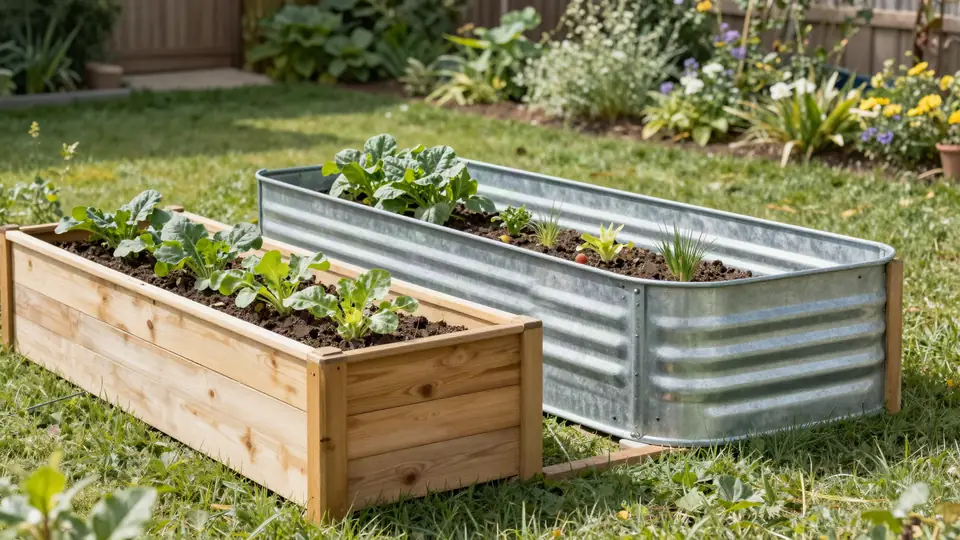
Long, slim metal beds
Modular panels are often sold in 2 × 6 and 2 × 8 formats, and they use space efficiently because the walls are thin. See 2 × 8 metal beds on Amazon.
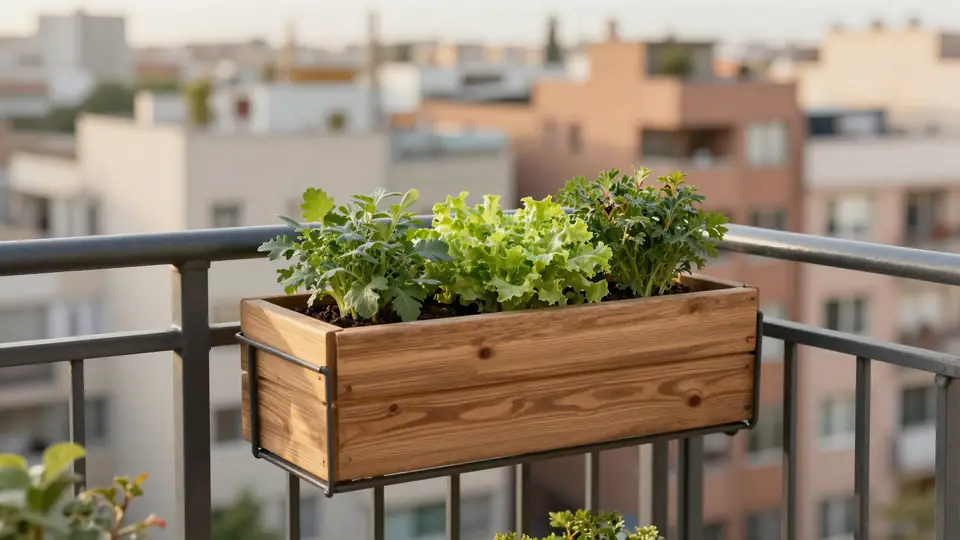
Wood trough planters
Good for a very narrow strip and easy to move. Look for drainage holes and a liner. See narrow wooden planters on Amazon.
Add a trellis
In a narrow bed, growing upward gives you the most food from the least ground. Fix it to the bed, not to the house wall. See raised bed trellises on Amazon.