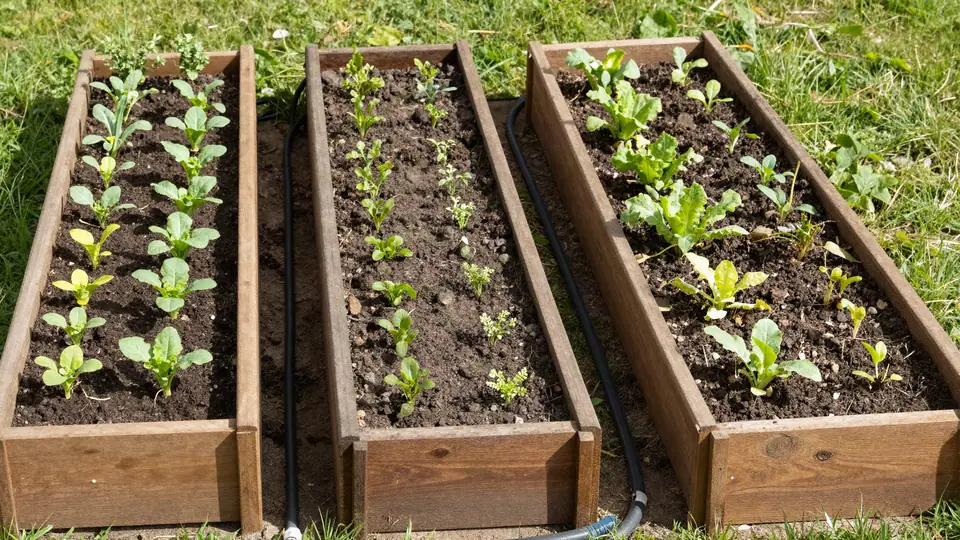
Short answer: with three lines per bed, four 4 × 8 beds need about 96 feet of 12-inch-spaced emitter line plus supply tubing. At 0.5 gallons per hour per emitter, that's about 54 gph, which most household taps can supply. Roughly 90 minutes applies about an inch of water.
The layout
The numbers
| Item | Per bed | Four beds |
|---|---|---|
| Emitter line (3 × 8 ft) | 24 ft | 96 ft |
| Emitters | 27 | 108 |
| Flow | 13.5 gph | 54 gph |
| Water for 1 inch | 20 gallons | 80 gallons |
| Time for 1 inch | About 90 minutes | |
Change any of these in the drip line calculator.
Check your water supply first
Fill a 1-gallon bucket from the tap you plan to use, and time it. If it takes 15 seconds, you have about 4 gallons a minute, or 240 gph. That's plenty for 54 gph. If you have a low-flow well or a long run of hose, split the beds into two zones.
Parts list
- Backflow preventer at the tap, to keep garden water out of your house supply.
- Timer, ideally with a manual option for testing.
- Filter. Emitters clog easily, and tiny passages need finer filtering.
- Pressure regulator matched to your drip line. Sources differ: Tennessee State University Extension says most drip tape runs at 6–15 psi, while retail kits often use a 25 psi regulator. Follow the rating of the tubing you buy.
- Supply tubing to carry water to all the beds, usually ½-inch.
- Emitter line, about 96 feet for this layout, plus extra for connections.
- Fittings: tees, elbows, valves, end caps and a hole punch.
- Stakes to keep the lines in place.
Parts usually go in this order from the tap: backflow preventer, timer, filter, regulator, then tubing. Check your kit's instructions.
Timer settings to start with
Crops are commonly said to need about 1 inch of water a week, and raised beds may need more in hot weather. Don't try to apply it all in one go. As a first setting, try about 30 minutes three times a week and check the soil a few inches down with your finger. Adjust it for weather, soil and crops.
What to look for
Multi-bed drip kit
Check that it includes at least 100 feet of emitter line, or the means to add it, along with a filter and regulator. See drip kits for multiple beds on Amazon.
Hose-end timer
Battery models are easiest to fit. Look for a rain-delay option and a manual mode. See hose timers on Amazon.
Using a rain barrel?
Standard parts need more pressure than a barrel gives. Look for low-pressure drip parts and a timer that is rated for gravity feed. See gravity-fed drip kits on Amazon.
Winterizing
In freezing climates, disconnect the timer and regulator, drain the lines, and store the parts indoors. Ice can crack fittings and timers.